Science & Nature
Argonne National Laboratory’s Advanced Photon Source Gets $815M Upgrade
Since 1995, Argonne National Laboratory, located just southwest of Chicago, has been at the forefront of atomic-scale research in the United States.
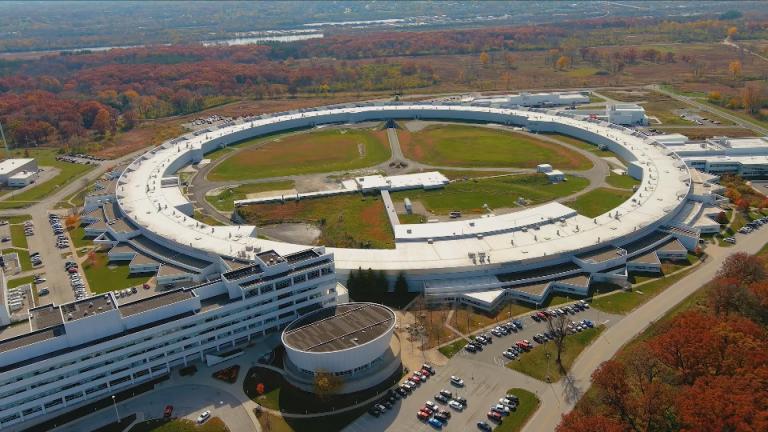
At the heart of that research is the Advanced Photon Source or APS — a huge particle accelerator that generates super bright X-rays by accelerating electrons to near light speed in a circular storage ring.
Those X-rays — billions of times brighter than a dental X-ray — are controlled by powerful magnets and diverted to more than 70 separate beam lines that have been used to probe all manner of things — from the structure of the COVID-19 virus, to microscopic defects in a jet engine turbine blade, to new battery designs.
But after nearly three decades and thousands of experiments, the APS was beginning to show its age. And in April 2023 it went offline to allow for an $815 million Department of Energy-funded upgrade.
Elmie Peoples-Evans is the project manager responsible for choreographing the complex logistical, engineering and technical dance required to complete the project.
“We started planning for this over 10 years ago,” said Peoples-Evans. “The upgrade came about as a way to take the existing APS facility to the next level. We wanted a brighter machine. They wanted to do different techniques and enhance the capabilities that we had. … We want to keep the APS as a world-leading machine.”
As the new, brighter beamlines come online, already scientists are benefitting from the improvements that have been made.
Shelly Kelly leads the spectroscopy group at Argonne.
“The old beam was typically about 1 millimeter high but maybe 10 millimeters wide,” said Kelly. “So now we’ve taken all of those X-rays that we had before and squeezed them into a 1 millimeter by 1 millimeter square area. … So in that 1 millimeter by 1 millimeter we have like 500 times the brightness that we had before.”
That greater brightness allows scientists from the Midwest and across the globe to study materials with much higher precision and at much faster speeds.
“We have the most brilliant X-rays in the world, especially in the high energy X-ray regime so if people need to push the limits of time and space, which many want to, they need to come here because this is the only place where they can do a certain amount of research,” said Jonathan Almer, who leads the Material Physics and Engineering Group at Argonne.
According to Mathew Cherukara, a computational scientist and leader of the Deep Learning Group at Argonne, the biggest change the upgrade brings is “in how many orders of scale of magnitude in a material we can access.”
“And so you can follow the changes in the material right from the atomic scale all the way up to the macro scale,” Cherukara said. “And we can do this in what we call a multimodal fashion, which means we can study different aspects of the material at the same time. It’s the difference between watching a move in black and white and watching it in color.”
Each year the unique capabilities of the APS attract more than 5,000 researchers from all fields of science to advance knowledge of materials and processes at the nanoscale.
“We have people doing a lot of chemistry, looking at batteries and new batteries,” Almer said. “We have a lot of users in the biological field, so they’re looking at proteins and new drugs for drug discovery, and we have people looking at material science engineering and they come in with a lot of energy and interesting problems from the different scientific domains.”
On the day of WTTW News’ visit, Almer was examining the turbine blade from a jet engine.
“Research scientists and engineers are interested in looking at the mechanical properties of these materials,” Almer said. “As you fly, you have stresses and temperatures that these things are subjected to. What this allows you to do is grain by grain, see how the stress is developed, see how they’re related, and see how cracks form.”
And small cracks that begin at the atomic scale can have big consequences.
“The fascinating thing about materials is that the concerted motion of a few 100 atoms or so can eventually lead to materials failure,” said Cherukara. “So a few atoms start moving together. They form what’s called a dislocation. These dislocations pile up. They cause a stress to build up in the material that leads to the formation of a crack. The crack grows and then a bridge collapses or an airplane engine fails.”
Because the upgraded APS can see in so much greater detail, that also means far more data to analyze. But Argonne researchers use Aurora, one of the world’s fastest supercomputers — capable of 2 billion billion calculations per second — and artificial intelligence to focus and refine their inquiries.
“We produce a lot of data, hundreds of petabytes a year,” Cherukara said. “So to put that in perspective, that’s tens of DVDs full of data every minute, and hidden in that data is insight into the problems that we’re trying to solve. We could interpret this data, but it would take a big computer crunching the numbers for a long period of time. Versus AI that would … do this in near real time and so providing feedback to the scientists to tweak their experiments, stop their experiment, pause, study things in a bit in more detail, and so on.”
Peoples-Evans said the project is about 98% done with hopes of completing the final elements of the upgrade by the end of September.
“Working on APSU has been challenging and I think it’s been probably the most thrilling thing I’ve done over my career,” said Peoples-Evans. “There have been ups, there have been downs, but I don’t think there’s much that I would change on how it all came together.”